
Summary
This page provides news and information about Zohran Mamdani in 2025 following his win in the Democratic Party primary election for New York City Mayor.
If Mamdani lost the primary election, then there would likely be little newsworthy content to report. Some news outlets may interpret a loss in the primary as an indication of the party rejecting a progressive agenda. Since Mamdani won, we move to the next phase of analysis and commentary.
Issues to Track
With Mamdani’s win, going forward, there will be several issues to track and discuss. Mamdani has stated that he wants to serve as an example of how cities can be properly managed using a progressive approach. Cities that are considered Democratic Party dominated are traditionally a target for criticism by those opposed to the party.
This will be an opportunity for progressive principles and policies to be applied, tested, and demonstrated to have measurable success — at least that would be the hope of progressives.
It’s inevitable that some policies and programs will fail. Perhaps 10% of them. When they do fail, those failures will be fodder for criticism. The 90% of programs that succeed will undoubtedly be ignored by critics.
Progressive Outcomes
Progressives, as the name suggests, seek to have outcomes that most people should be able to agree on as offering a better condition for all involved:
- EDUCATION — Access to affordable education leading to jobs and careers that provide a good income.
- EMPLOYMENT — Job creation resulting in more people employed.
- HEALTHCARE — More people with access to healthcare.
- HOUSING — Affordable housing, while at the same time having property owners being able to pay taxes and cover the cost of upkeep for properties.
- OWNERSHIP — Businesses that are employee owned where distributed profit sharing results in wealth and reward to those who help create the wealth.
- WAGES — More people having a livable wage, while at the same time having businesses that experience sustainable revenue.
Progressives must produce working practical models for achieving the above.
The Republican Formula
Some Republican governors have quietly accomplished all of the above in their states in a way that makes it not look like socialism.
In those states, the formula is to provide everyone with access to vocational education and career-track business partnerships that mostly guarantee employment.
Those millions of people with education, skills, and experience, earn beyond a livable wage. They earn an abundance wage.
In those states, affordable housing isn’t created by demanding lowering rent or providing subsidies, but by training people to fill high-paying jobs so they can afford high-quality housing. Those high-paying jobs also come with great healthcare.
States that use this formula are so prosperous that they are able to afford a social safety net to support those who for some reason don’t thrive despite having access to opportunities.
This is how states like Tennessee ensure a workforce readiness that brings in billions of dollars from companies that setup factories and manufacturing operations. The program is called Tennessee Promise. In a similar way, Utah reduced chronic homelessness by 91 percent. [Source: NPR, 10 Dec 2015]
It’s not a guaranteed solution for everyone, but it’s an approach that significantly reduces poverty and promotes success and wellbeing.
A progressive model needs to deliver on all these outcomes and somehow do it better.
It is important to note that not all Republicans are in favor of empowering the masses with access to education, jobs, and healthcare. They believe it is more profitable and desirable to have poverty and despair so millions of people will be willing to work for low wages in harmful conditions without complaining. It also discourages whistleblowers, political dissent, and uprisings.
Optimal Community Size
There is likely an ideal size and population for cities to experience maximum efficiency. Beyond a certain size, we are likely to see an increase in cost of living due to hidden inefficiencies.
Examples of inefficiencies in a large city may include:
- Pollution from cars and trucks sitting in traffic. The pollution hinders wellness. This results in more sick days with productivity lost and costly healthcare expenses shared across the larger population.
- Limited green spaces where people can be renewed and restored, thus higher levels of stress. Most cities have a city park, which is nice for people who live nearby, but for everyone to benefit from green spaces they need to be spread throughout the city.
- Traffic can result in delays, stress, pollution, road rage, injuries, and costly accidents.
- In big cities, small neighborhoods can create a small-town sense of neighborly familiarity, friendliness, and depth to relationships. Yet, there will still be millions of people a few blocks away that you don’t know or recognize. Higher density in a smaller area brings the statistically inevitable poverty and crime into closer proximity.
There is likely a longer list that could be itemized, but in general the challenges of a large city are going to produce some undesirable outcomes regardless of the party affiliation of city leadership. To understand this better, study the challenges faced by the world’s 20 largest cities (for example). Big cities have benefits, but also challenges.
Mamdani will likely be blamed for problems in the city that are systemically prevalent in all cities. Hopefully some creative solutions, with collaborative engagement, and a diversity of stakeholders involved, will result in good outcomes.
Right-Sized Towns
It would be much easier to be successful in a more manageable-sized community. Many rural and smaller communities, identified as being predominantly Republican, are successful in part due to the size of those communities.
Drive through a small town and reflect on the low levels of pollution, crime, homelessness, and the welcome presence of neighborliness. You’ll conclude that whoever manages that town is doing a good job. Everyone is so friendly and seems to know each other. That’s not necessarily a result of innovative city management, but something observed all over the world throughout history.
When a community is too small, it can lack some of the resources that enrich lives such as higher education, the arts, industry, and good paying jobs. So, the right balance is important.
An analysis of Mamdani’s success should be viewed against the backdrop of this context.
The Good Country Index
The Good Country Index is a quality of life measurement for countries. [View Results] A similar system of measuring quality of life could be applied to cities. Those metrics and outcomes would be the basis for creating a plan to achieve better outcomes for urban centers.
Ideological Opposition
Much of the opposition to Mamdani is based on ideological opposition:
- ANTI-CORDIALITY — In this campaign, Mamdani and an opponent cross-endorsed each other. They spoke respectfully of one another. This sort of cooperation, respect, and cordiality infuriate those who strongly believe you must be a cruel alpha-dog bully to win in politics and in life. Mamdani’s win is a proof of concept for those who believe that politics need not be aggressively competitive. [Learn More]
- ANTI-PROGRESSIVE — Some people in the Democratic Party believe they could win more elections if they would be more moderate. This was the rationale for attacking the Bernie Sanders campaign in 2016, and similar candidates over the past 9 years. That strategy hasn’t worked very well. So, Mamdani’s win is proof positive that a progressive platform of change, renewal, and innovation can win.
There may be other similar ideological issues that result in opposition to Mamdani.
Trump “Endorsement”
Many politicians on “the left” are not even deemed worthy of receiving derogatory nickname from President Trump. They are viewed as inconsequential. Mamdani has received one of the strongest criticisms (endorsements) ever issued by Trump. The statement is shown below and followed by a translation.
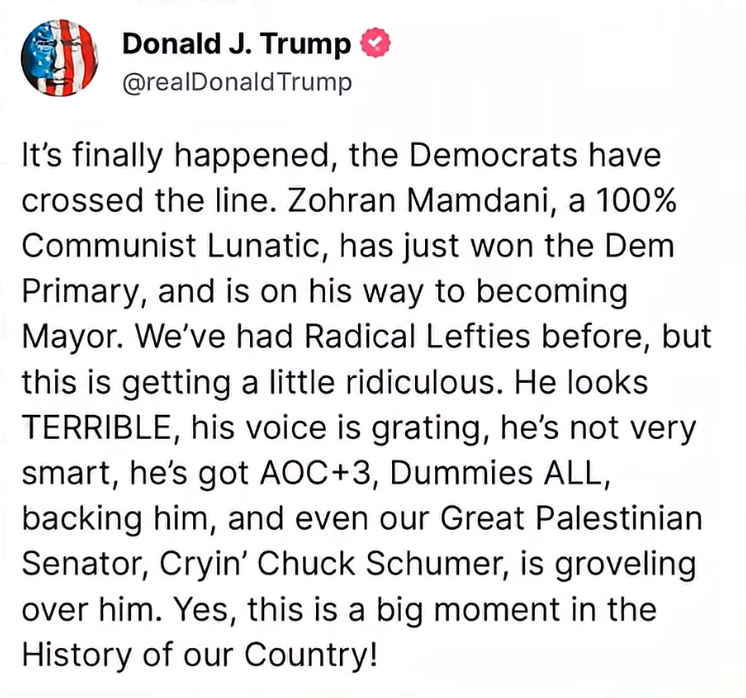
TRANSLATION
This is a rough translation from “Trump Speak” above to plain English that will clarify what is being communicated above:
- Zohran Mamdani looks fabulous. He has the voice of a professional radio announcer. He is very smart and articulate. He is personable. He is young. He is energetic. People like him. He is rational and fair. He is asking for reasonable concessions and livable conditions for the people of New York City. He will likely be successful because his policies and programs will produce good outcomes. His success will be a glaring contrast to the multiple failings of incompetent people in power. For these reasons, I don’t like him. I’m generally made uncomfortable by articulate, smart, competent, great looking men. I must demean him publicly and use the power of my position to attack him.
UPDATE: 24 Nov 2025 — About 5 months after this document was posted, President Trump invited Zohran Mamdani to the White House. In a press conference with Trump and Mamdani, there were many positive comments and complements between the two leaders. The video below from 21 Nov 2025 is provided by the White House via YouTube [Source]
If you listen to Mamdani in the news reports below, you can make your own conclusions about Mamdani.
Selected Criticism
- Bloomberg, 26 Jun 2025, Former US Treasury Secretary Lawrence Summers says if Zohran Mamdani is the next mayor of New York City, it will be a great gift for the economies of Florida and Texas. He says the democratic socialist’s policies would hurt the city and there would be “massive outmigration.” Summers speaks to David Westin on “Wall Street Week.” [Watch]
- Fox News, 27 Jun 2025, Former Biden White House director Meghan Hays and former NRSC senior advisor Matt Whitlock weigh in on how Democratic socialist mayoral candidate Zohran Mamdani is dividing the Democratic Party on ‘America Reports.’ [Watch]
- Fox News, 3 Jul 2025, This report brings together various viewpoints including the claim that Zohranomics is “Trotskyite economic policies” and that Zohran is an antisemitic socialist. [Watch]
Suggestions for Mamdani Team
Here are some requests and suggestions for the Mamdani team.
- EXTERNAL ENGAGEMENT — New York City is a microcosm of the cultural diversity that we see in the United States. It is an iconic American city and known all over the world. People in the United States and those from other countries have an interest in New York City. It is a popular tourist destination. So, it would be thoughtful and helpful to have an outreach and engagement program that connects with people outside of the city. In this way, local municipal governance can continue in a focused uncluttered way, while a separate outside engagement agency can handle the publicity and inquiries that come from the outside. City managers facing similar challenges may want to learn how New York City is addressing the various needs of a municipality. Online training could be made available, as well as annual conferences for those who want to study the city.
- SISTER CITY — It would be very helpful for New York City to establish a sister city in the spirit of cooperation and respectful dialog. The sister city should be one considered to be mostly Republican, conservative, capitalist focused, and under management of a Republican mayor. The two cities could have public forums with Q&A sessions. These would be an opportunity for both cities to share what works and what doesn’t work in their approaches to challenges. The cities could both acknowledge that some challenges are difficult to address regardless of who is managing the city. There could be friendly competitions between the two cities.
News
Below are news stories about Mamdani listed in chronological order with the source and date as a heading.
MSNBC (19 Jul 2025)
MSNBC (16 Jul 2025)
News 12 (13 Jul 2025)
ABC 7 NY (9 Jul 2025)
MSNBC (6 Jul 2025)
Ezra Klein (3 Jul 2025)
NPR (1 Jul 2025)
Zohran (1 Jul 2025)
MSNBC (30 Jun 2025)
Bloomberg (29 Jun 2025)
After this week’s democratic primary election for New York City mayor, Wall Street has more questions than answers. Partnership for New York’s President and CEO Kathryn Wylde says the disconnect between Wall Street and Zohran Mamdani’s supporters explains the attractiveness of progressive policies in a city that symbolizes capitalism. Harvard Economist Ed Glaeser has studied the success and failure of democratic socialist ideals in cities across the United States and warns that New York is facing a “maximally risky moment.”
Fox 5 New York (29 Jun 2025)
Zohran Mamdani spoke with Reverend Al Sharpton at a National Action Network rally held in Harlem. FOX 5 NY’s Meredith Gorman has the latest.
Mamdani via YouTube (28 Jun 2025)
MSNBC (28 Jun 2025)
Zohran Mamdani’s major upset against Andrew Cuomo in the New York City mayoral primary election sent a clear message that voters want change within their party. Former NY Rep. Mondaire Jones joins “The Weekend: Primetime” to discuss the lessons learned from Mamdani’s success.
Al Jazeera (27 Jun 2025)
CNBC (27 Jun 2025)
MSNBC (27 Jun 2025)
CNN (26 Jun 2025)
Forbes (26 Jun 2025)
ABC7 NY (25 Jun 2025)
MSNBC (25 Jun 2025)
CBS – Colbert (23 Jun 2025)
If the video below doesn’t play here, you can watch it on YouTube. [View]
Zohran Mamdani (22 Jun 2025)
Eric Hovagim (14 Jun 2025)
Mandani & Lander Promo (13 Jun 2025)
Breakfast Club Show (11 Jun 2025)
Zohran Mamdani (4 Jun 2025)
If the video below doesn’t play here, you can view it on YouTube. [View]
Zohran at First Baptist Church of Crown Heights (21 Feb 2025)
Zeteo (5 Dec 2024)
Mehdi Hasan sits down with candidate Zohran Mamdani to discuss why New York City could elect a Socialist as its next mayor.
1 comment
Comments are closed.